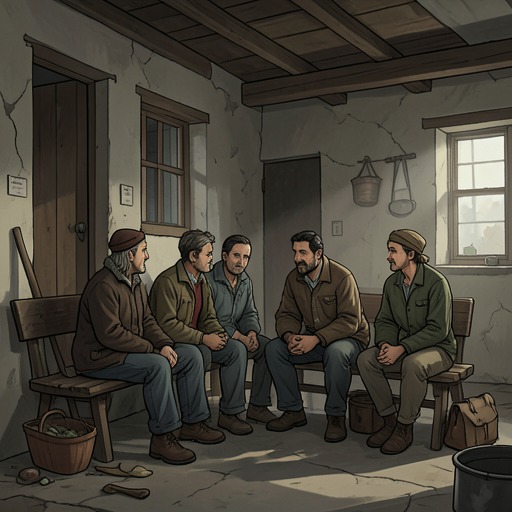
“We wear our deformities in the open”
Norwegian Wood“We wear our deformities in the open” is the phrase that gives Ami Hostel’s quiet, communal life its governing logic: people live together by recognizing their differences instead of concealing them or demanding that they be fixed. The phrase presents openness as a condition of mutual care, while the novel’s account of Naoko’s worsening illness also shows the limits of what that care can do.
Meaning and Setting
Ami Hostel is a convalescent community rather than an ordinary hospital. About seventy residents live there alongside just over twenty staff members, in a spacious, nature-filled setting where daily life is quiet. Its calm depends on particular preconditions: it is a small, sheltered world, not a model that can simply be equated with ordinary life outside.
Residents take part in shared activities, including sports and growing vegetables. During basketball games, staff and residents play on the same teams; the narrator observes that he loses track of which people are patients and which are staff, and that everyone seems equally “deformed.” The game makes visible the phrase’s reversal of conventional categories: difference is not confined to a marked group when everyone is understood to have their own.
The Principle of Open Difference
The doctor in charge of the narrator’s case explains that the aim is not to correct people’s “deformation,” but to help them become accustomed to it. People have distinctive ways of walking, thinking, feeling, and seeing; attempts to force a change may not work and may unsettle something else. The explanation is explicitly limited, but it offers a practical alternative to treating difference as a defect that can be removed on command.
The narrator understands the community as a place where people can live without hurting one another or being hurt because they know themselves to be different. Outside, people may move through life unconscious of their own deformities; at Ami Hostel, those differences are openly acknowledged. The comparison to people wearing feathers to show their tribal affiliation makes the phrase both social and visible: residents do not have to pass as unmarked or pretend to normality in order to belong. Their quiet way of living is tied to this shared recognition.
Care, Work, and Daily Life
The phrase is not only an idea spoken by the doctor. Shared routines give it a lived form. Residents and staff play sports together, and residents cultivate vegetables in greenhouses, drawing on books, expert advice, and sustained conversation about soil and fertilizer. Growing food, eating fresh produce, and exercising belong to an ordinary schedule that helps make the community inhabitable.
The boundary between care and institutional roles is also blurred in Reiko’s life. She has been at Ami Hostel for seven years, teaches music as a kind of therapy, and helps in the office; because of this work, it has become difficult to tell whether she is a patient or staff member. She describes the hostel as a place for convalescence, with doctors checking residents’ condition rather than administering the treatments associated with an ordinary hospital. People enter and leave voluntarily, and the community suits only those able to undertake that kind of convalescence. Openness here is therefore not simply disclosure: it is supported by a particular environment and a form of care with defined limits.
Limits of the Principle
Naoko’s condition tests those limits. After a long talk involving Naoko, her mother, the doctor, and Reiko, the group concludes that Naoko should transfer to a hospital for intensive treatment, with the possibility of returning to Ami Hostel depending on the outcome. Although Naoko would prefer to remain, her emotions have become increasingly unstable, and during episodes of hearing voices she shuts down so completely that staff cannot take their eyes off her. Reiko agrees that the hostel cannot provide all the care she needs at that point.
This decision does not simply cancel the community’s principle. It distinguishes accepting a person as they are from claiming that one setting can meet every need. The phrase describes a practice of living with difference without demanding its erasure; it does not assert that suffering is harmless or that convalescence can replace specialized treatment. Ami Hostel’s welcome and its limits belong to the same account of care.